
- New
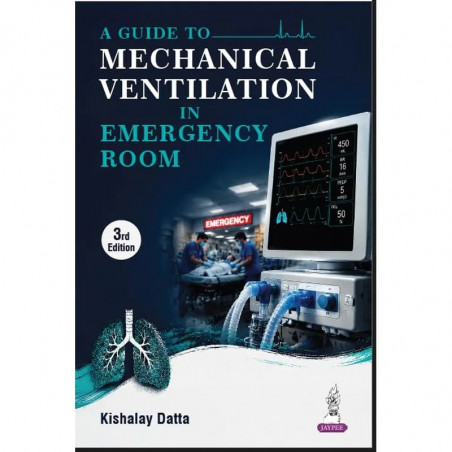
| Title | A Guide to Mechanical Ventilation in Emergency Room, 3/E for Emergency Medicine Residents, Intensivists and Critical Care Nurses | Ventilator Modes, Settings, Graphics, NIV and Weaning: 1 |
| Author | Kishalay Datta |
| ISBN-13 | 9788167995414 |
| Publication | Jaypee Brothers Medical Publishers |
 For General Enquiries E-mail support@madrasshoppe.com
 COD Available. Delivery Time 4 - 7 Working Days in India.
 Trusted by over 100K+ customers. Verified and Trusted Cashfree Online Payment
A Guide to Mechanical Ventilation in Emergency Room brings the topics needed at the ventilator under one roof, presented in simple and easy language for the emergency room and the intensive care unit. This third edition has been revised thoroughly and completely, and adds separate new chapters. 'Airway Management: The Essentials' is an entirely new chapter covering airway assessment, rapid sequence intubation, confirmation of endotracheal tube placement, the approach to difficult intubation, supraglottic and tracheostomy devices, oxygen delivery and high-flow nasal cannula. 'Drugs Used for Mechanical Ventilation' is also new, covering the ideal sedation agent, induction agents and paralytic agents. A further new chapter addresses ventilator-induced lung injury and ventilator-associated pneumonia, and the chapter on noninvasive ventilation has been completely revised and re-edited. The book is organised in two sections: the basics of respiration — the act of breathing, pulmonary gas exchange, respiratory physiology — followed by mechanical ventilation itself, from initiation and ventilatory modes through inspiratory pressures and flow profiles, PEEP, general ventilator settings, monitoring, complications, weaning parameters, disease-specific ventilatory strategies and ventilatory graphics. Who This Book Is For: Emergency medicine postgraduates, residents and interns who have to make ventilation decisions early and under pressure. Intensivists, critical care nurses, respiratory physiotherapists, technicians and biomedical staff working with ventilated patients in the emergency room and the ICU. Why This Book Helps: Indications for starting ventilation are reduced to three heads — hypoxia, high work of breathing and hypoventilation — with numeric thresholds and pulmonary-mechanics criteria alongside, and an explicit reminder that these serve as a guide rather than a substitute for clinical judgement. Disease-specific ventilatory strategies are set out separately for COPD and asthma, flail chest, head injury, neuromuscular disease, myocardial infarction and heart failure, and acute respiratory distress syndrome with recruitment steps. The monitoring chapter covers waveform capnography, ventilator alarms and troubleshooting, so an alarm becomes a diagnostic starting point. The ventilatory graphics chapter works through scalar graphics, volume-versus-time and pressure-versus-time curves and loop graphics, with enhanced images in this edition. General ventilator settings are covered field by field, with settings by mode selection and settings for better oxygenation, making the book usable as a quick reference during a shift. Key Features: 19 chapters across two sections — basics of respiration, and mechanical ventilation. New in this edition: 'Airway Management: The Essentials' and 'Drugs Used for Mechanical Ventilation', plus a chapter on ventilator-induced lung injury and ventilator-associated pneumonia. Noninvasive ventilation completely revised and re-edited, including weaning and complications. Ventilator settings covered field by field — tidal volume, respiratory rate, minute ventilation, fraction of inspired oxygen, PEEP, inspiration-expiration ratio, flow rate, slope, trigger sensitivity and peak and plateau pressures. Chief contributors practising in the UK and India, and a full abbreviations list for quick lookup.
Kishalay Datta is the author of A Guide to Mechanical Ventilation in Emergency Room, 3/E for Emergency Medicine Residents, Intensivists and Critical Care Nurses | Ventilator Modes, Settings, Graphics, NIV and Weaning: 1.
Disclaimer:
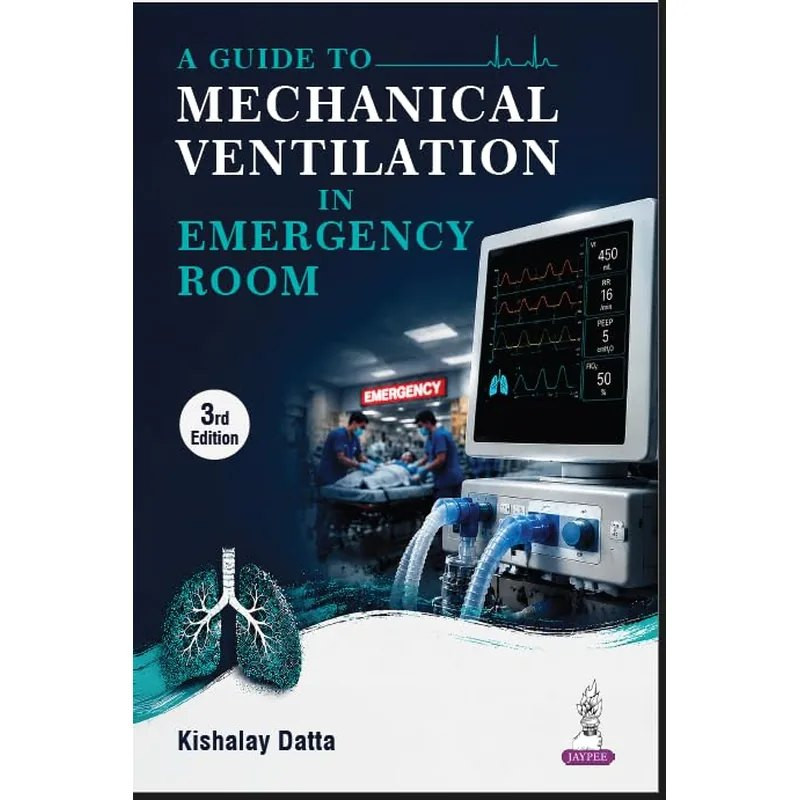
| Title | A Guide to Mechanical Ventilation in Emergency Room, 3/E for Emergency Medicine Residents, Intensivists and Critical Care Nurses | Ventilator Modes, Settings, Graphics, NIV and Weaning: 1 |
| Author | Kishalay Datta |
| ISBN-13 | 9788167995414 |
| Publication | Jaypee Brothers Medical Publishers |