- Reduced price
- New
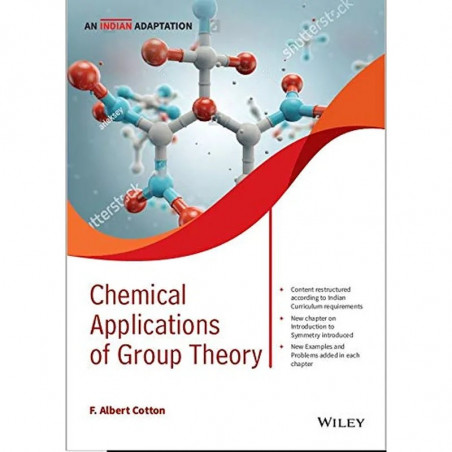

| Title | Chemical Applications of Group Theory, An Indian Adaptation |
| Author | F. Albert Cotton |
| ISBN-13 | 9788194726364 |
| Publication | WILEY |
Chemical applications of group theory is a well-established textbook that explains the principles of molecular and crystallographic Symmetry and their immense significance. It aims to teach the use of Symmetry arguments to the typical experimental chemist in a meaningful and useful manner and serves as the first introduction for students intending to pursue theoretical work in the field. It retains the easy-to-read format and informal flavour of the previous editions and includes new material on the symmetric properties of extended arrays (crystals), projection operators, LCAO molecular orbitals, and electron counting rules.
 For General Enquiries E-mail support@madrasshoppe.com
 COD Available. Delivery Time 4 - 7 Working Days in India.
 Trusted by over 100K+ customers. Verified and Trusted RazorPay Online Payment
Chemical applications of group theory is a well-established textbook that explains the principles of molecular and crystallographic Symmetry and their immense significance. It aims to teach the use of Symmetry arguments to the typical experimental chemist in a meaningful and useful manner and serves as the first introduction for students intending to pursue theoretical work in the field. It retains the easy-to-read format and informal flavour of the previous editions and includes new material on the symmetric properties of extended arrays (crystals), projection operators, LCAO molecular orbitals, and electron counting rules.
F. Albert Cotton is the author of Chemical Applications of Group Theory, An Indian Adaptation.
Disclaimer:
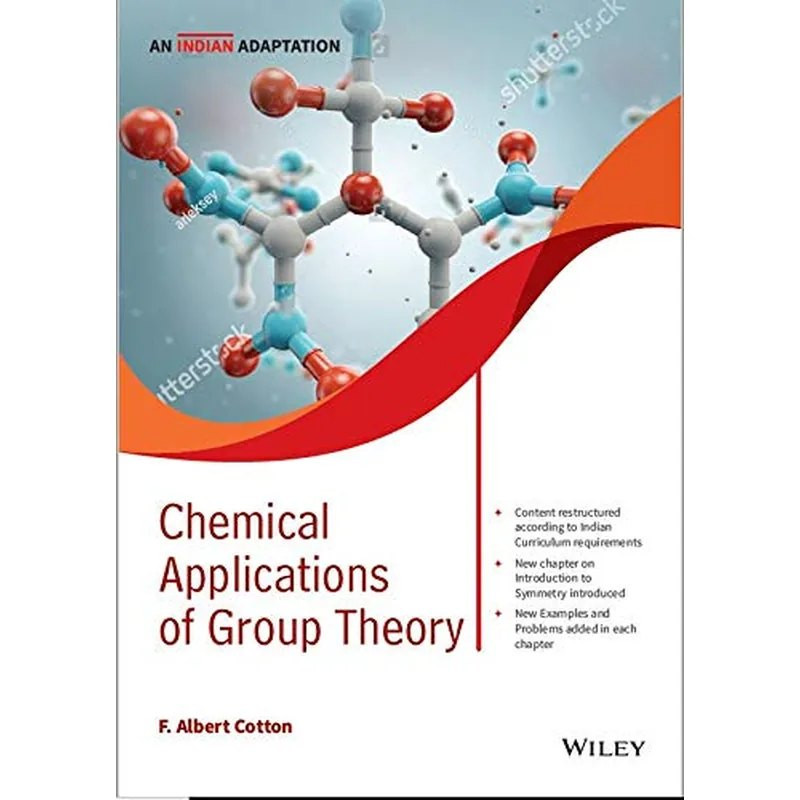
| Title | Chemical Applications of Group Theory, An Indian Adaptation |
| Author | F. Albert Cotton |
| ISBN-13 | 9788194726364 |
| Publication | WILEY |
Chemical applications of group theory is a well-established textbook that explains the principles of molecular and crystallographic Symmetry and their immense significance. It aims to teach the use of Symmetry arguments to the typical experimental chemist in a meaningful and useful manner and serves as the first introduction for students intending to pursue theoretical work in the field. It retains the easy-to-read format and informal flavour of the previous editions and includes new material on the symmetric properties of extended arrays (crystals), projection operators, LCAO molecular orbitals, and electron counting rules.