
- New
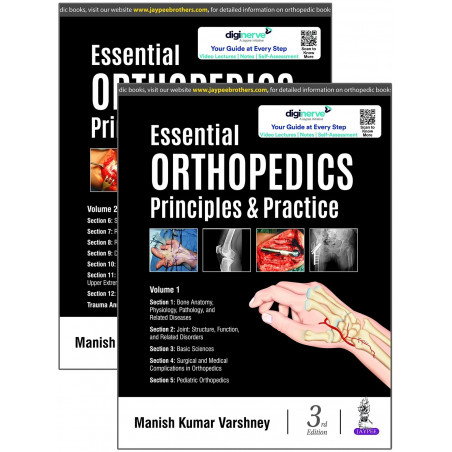
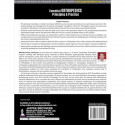
| Title | Essential Orthopedics: Principles & Practice (2 Vols Set), 3/E for Orthopedic Postgraduates (MS/DNB) | 2500+ Illustrations with New Trauma Annexures on Fracture Management |
| Author | Manish Kumar Varshney |
| ISBN-13 | 9789354651052 |
| Publication | Jaypee Brothers Medical Publishers |
 For General Enquiries E-mail support@madrasshoppe.com
 COD Available. Delivery Time 4 - 7 Working Days in India.
 Trusted by over 100K+ customers. Verified and Trusted RazorPay Online Payment
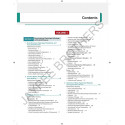
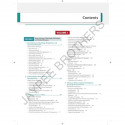
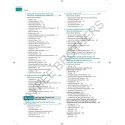
Essential Orthopedics: Principles & Practice, 3/E is a comprehensive, two-volume postgraduate core textbook spanning 2328 pages across 130 chapters, organized into 12 body-region and topic-based sections so correlated concepts stay together. This third edition adds an entirely new trauma component - four Annexures covering Upper Limb Trauma, Lower Limb Trauma, Fractures of the Axial Skeleton, and Neglected Trauma to Bones and Joints - that together describe nearly all of the commonly encountered fractures, alongside the book's existing elective-orthopedics core. Volume 1 builds the foundation: bone anatomy, physiology, pathology and metabolic bone disease; joint structure and disorders including arthritis and infective arthritides; basic sciences such as biomechanics, biomaterials, tribology, bone cement, regenerative medicine, 3D printing, and gene therapy; surgical and medical complications in orthopedics from shock and thromboembolism to compartment syndrome and polytrauma; and a full section on pediatric orthopedics. Volume 2 moves through sports medicine and then region by region across the shoulder, hip, foot and ankle, spine, and hand and upper extremity, closing with miscellaneous topics such as amputation and prosthetic rehabilitation, robotics, lasers, instruments and implants, and the history of orthopedics. Difficult and advanced concepts are deliberately presented in point form so the core postgraduate curriculum stays clear of clutter, while still flagging the specialized-practice detail that goes beyond routine PG requirements. The text is built to directly support postgraduate theoretical examination preparation, and nearly every concept is reinforced with a relevant illustration - more than 2500 in all, spanning clinical photographs, radiographs, classification diagrams, flowcharts, and comparative tables - so concepts are grasped quickly and retained. Who This Book Is For: Orthopedic Postgraduates (MS/DNB): follows the exact scope and depth of postgraduate theoretical examination papers, with advanced-only detail clearly separated from core curriculum content. Orthopedic Surgeons: the specialized-practice-level detail on biomaterials, arthroplasty, bearing surfaces, and regenerative techniques supports day-to-day specialized clinical decision-making. Orthopedic Trauma Surgeons: the four new Trauma Annexures on upper limb, lower limb, axial skeleton, and neglected trauma give a dedicated, fracture-by-fracture reference alongside the elective-orthopedics core. Orthopedic Residents: the region-by-region structure across 12 sections mirrors clinical postings, making it straightforward to read alongside ward and OT rotations. Fellowship Trainees: dedicated chapters on emerging areas - robotics, 3D printing, gene therapy, nanotechnology, and bariatric surgery's impact on arthroplasty - extend the text into subspecialty-level territory. Why This Book Helps: Matches the postgraduate exam pattern directly: lucid text built around the questions actually asked in postgraduate theoretical examination papers, which the book's own preface notes are otherwise difficult to find covered together in one text. Separates core from advanced content: difficult and advanced concepts are called out in point form so trainees are not overburdened by detail meant for specialized practice, while still having it available for later reference. Fills the basic-science gap: a dedicated Basic Sciences section covers biomechanics, biomaterials, tribology, bone cement, and regenerative medicine in the depth the book's own preface says is often missing from dedicated orthopedics texts. Adds a comprehensive trauma primer: four new Trauma Annexures give body-region trauma coverage that was not part of earlier editions, closing a gap for fracture-pattern reference. Organizes by body region for faster recall: sections are divided by anatomical region rather than mixed by topic, so related conditions, biomechanics, and surgical approaches for one joint can be studied together. Key Features: 130 chapters across 2 volumes organized into 12 body-region and topic-based sections, plus 4 new Trauma Annexures. More than 2500 illustrations - clinical photographs, radiographs, classification diagrams, flowcharts, and comparative tables - supporting nearly every concept. Dedicated Basic Sciences section covering biomechanics, biomaterials, tribology and bearing surfaces, bone cement, regenerative medicine and stem cells, 3D printing, and gene therapy in orthopedics. New trauma coverage spanning Upper Limb Trauma, Lower Limb Trauma, Fractures of the Axial Skeleton, and Neglected Trauma to Bones and Joints. Emerging-topics chapters on robotics and computers in orthopedics, lasers, nanotechnology, and the impact of bariatric surgery on joint arthroplasty.
Manish Kumar Varshney is the author of Essential Orthopedics: Principles & Practice (2 Vols Set), 3/E for Orthopedic Postgraduates (MS/DNB) | 2500+ Illustrations with New Trauma Annexures on Fracture Management.
Disclaimer:
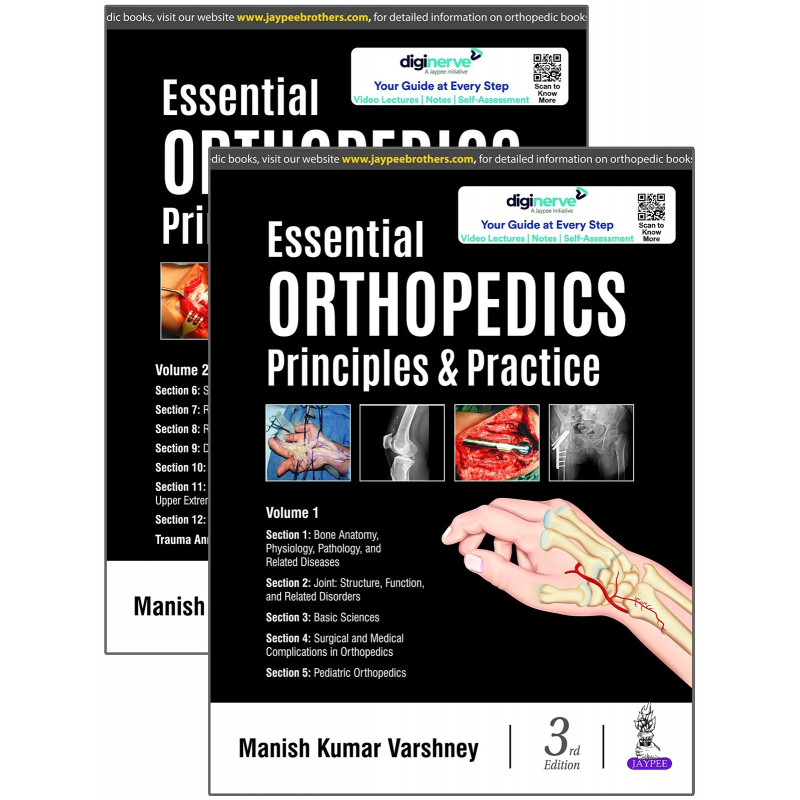
| Title | Essential Orthopedics: Principles & Practice (2 Vols Set), 3/E for Orthopedic Postgraduates (MS/DNB) | 2500+ Illustrations with New Trauma Annexures on Fracture Management |
| Author | Manish Kumar Varshney |
| ISBN-13 | 9789354651052 |
| Publication | Jaypee Brothers Medical Publishers |