
- New
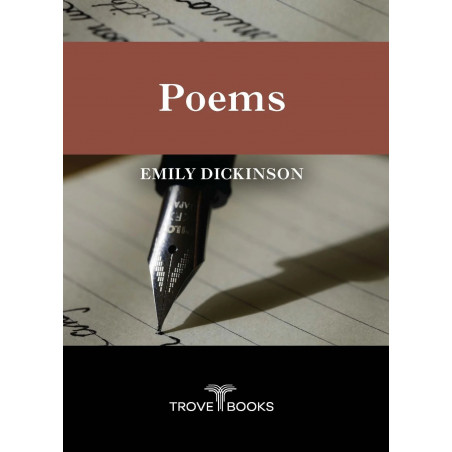
| Title | Poems |
| Author | Emily Dickinson |
| ISBN-13 | 9789395987585 |
| Publication | NEWGEN TROVE BOOKS |
Emily Dickinson, the noteworthy American poet of the 1800s and 1900s is widely known for her innovative use ofslant-rhyme, conceits and unconventional punctuation. She is also known for her strange ways of life. She lived her life as a legendary recluse in spite of belonging to a prominent Amherst, Massachusetts family. Emily Dickinson’s best-known and most loved poems carry a strong sense of pathos. Some of them happily focus on the personification of hope. The poem, ‘Hope is the Thing with Feathers’ depicts a bird that perches inside her soul and sings a soulful song. The bird is shown to be a source of hope and peace. This poem is a brilliant example of Dickinson’s use of nature as a metaphor to express the most complicated of human emotions. In some other poems such as ‘I felt a Funeral, in my Brain’, the poetess harps on life and death, and uses metaphors to discuss endings, beginnings and the constant fear of losing sanity. The speaker expresses the sorrow of losing soundness of mind at the sight of the mourners whom she visualizes and which stays strong in her mind’s eye. She falls in a cyclical trap from which she finds no respite. Another prevalent theme is sleep and death. Dickinson longs for death rather than live a life of suffering and loneliness without the solace of pleasure or peace. She also speaks of the various paths that lead to death and finally, for her whatever the path is, truth or beauty or something else, it is death that is important. She also dwells on truth and its interpretation. For her, complicating naked truth, makes it more interesting and arouses greater curiosity among humankind
 For General Enquiries E-mail support@madrasshoppe.com
 COD Available. Delivery Time 4 - 7 Working Days in India.
 Trusted by over 100K+ customers. Verified and Trusted Cashfree Online Payment
Emily Dickinson, the noteworthy American poet of the 1800s and 1900s is widely known for her innovative use ofslant-rhyme, conceits and unconventional punctuation. She is also known for her strange ways of life. She lived her life as a legendary recluse in spite of belonging to a prominent Amherst, Massachusetts family. Emily Dickinson’s best-known and most loved poems carry a strong sense of pathos. Some of them happily focus on the personification of hope. The poem, ‘Hope is the Thing with Feathers’ depicts a bird that perches inside her soul and sings a soulful song. The bird is shown to be a source of hope and peace. This poem is a brilliant example of Dickinson’s use of nature as a metaphor to express the most complicated of human emotions. In some other poems such as ‘I felt a Funeral, in my Brain’, the poetess harps on life and death, and uses metaphors to discuss endings, beginnings and the constant fear of losing sanity. The speaker expresses the sorrow of losing soundness of mind at the sight of the mourners whom she visualizes and which stays strong in her mind’s eye. She falls in a cyclical trap from which she finds no respite. Another prevalent theme is sleep and death. Dickinson longs for death rather than live a life of suffering and loneliness without the solace of pleasure or peace. She also speaks of the various paths that lead to death and finally, for her whatever the path is, truth or beauty or something else, it is death that is important. She also dwells on truth and its interpretation. For her, complicating naked truth, makes it more interesting and arouses greater curiosity among humankind
Emily Dickinson is the author of Poems.
Disclaimer:
| Title | Poems |
| Author | Emily Dickinson |
| ISBN-13 | 9789395987585 |
| Publication | NEWGEN TROVE BOOKS |
Emily Dickinson, the noteworthy American poet of the 1800s and 1900s is widely known for her innovative use ofslant-rhyme, conceits and unconventional punctuation. She is also known for her strange ways of life. She lived her life as a legendary recluse in spite of belonging to a prominent Amherst, Massachusetts family. Emily Dickinson’s best-known and most loved poems carry a strong sense of pathos. Some of them happily focus on the personification of hope. The poem, ‘Hope is the Thing with Feathers’ depicts a bird that perches inside her soul and sings a soulful song. The bird is shown to be a source of hope and peace. This poem is a brilliant example of Dickinson’s use of nature as a metaphor to express the most complicated of human emotions. In some other poems such as ‘I felt a Funeral, in my Brain’, the poetess harps on life and death, and uses metaphors to discuss endings, beginnings and the constant fear of losing sanity. The speaker expresses the sorrow of losing soundness of mind at the sight of the mourners whom she visualizes and which stays strong in her mind’s eye. She falls in a cyclical trap from which she finds no respite. Another prevalent theme is sleep and death. Dickinson longs for death rather than live a life of suffering and loneliness without the solace of pleasure or peace. She also speaks of the various paths that lead to death and finally, for her whatever the path is, truth or beauty or something else, it is death that is important. She also dwells on truth and its interpretation. For her, complicating naked truth, makes it more interesting and arouses greater curiosity among humankind